
Water extraction removes standing water and pulls water out of carpet, pad and hard floors with pumps and extractors. It is the first step of any flood job and it has to happen before drying equipment can do its work.
One inch of water over 1,000 square feet is about 620 gallons. A pump can move that in a short time, but a mop cannot, and a household vacuum is not rated for it and is not safe near standing water. The number matters because it explains why a room that looks like it has a puddle can hold more water than you would guess once you count the carpet pad and the bottom of the walls.
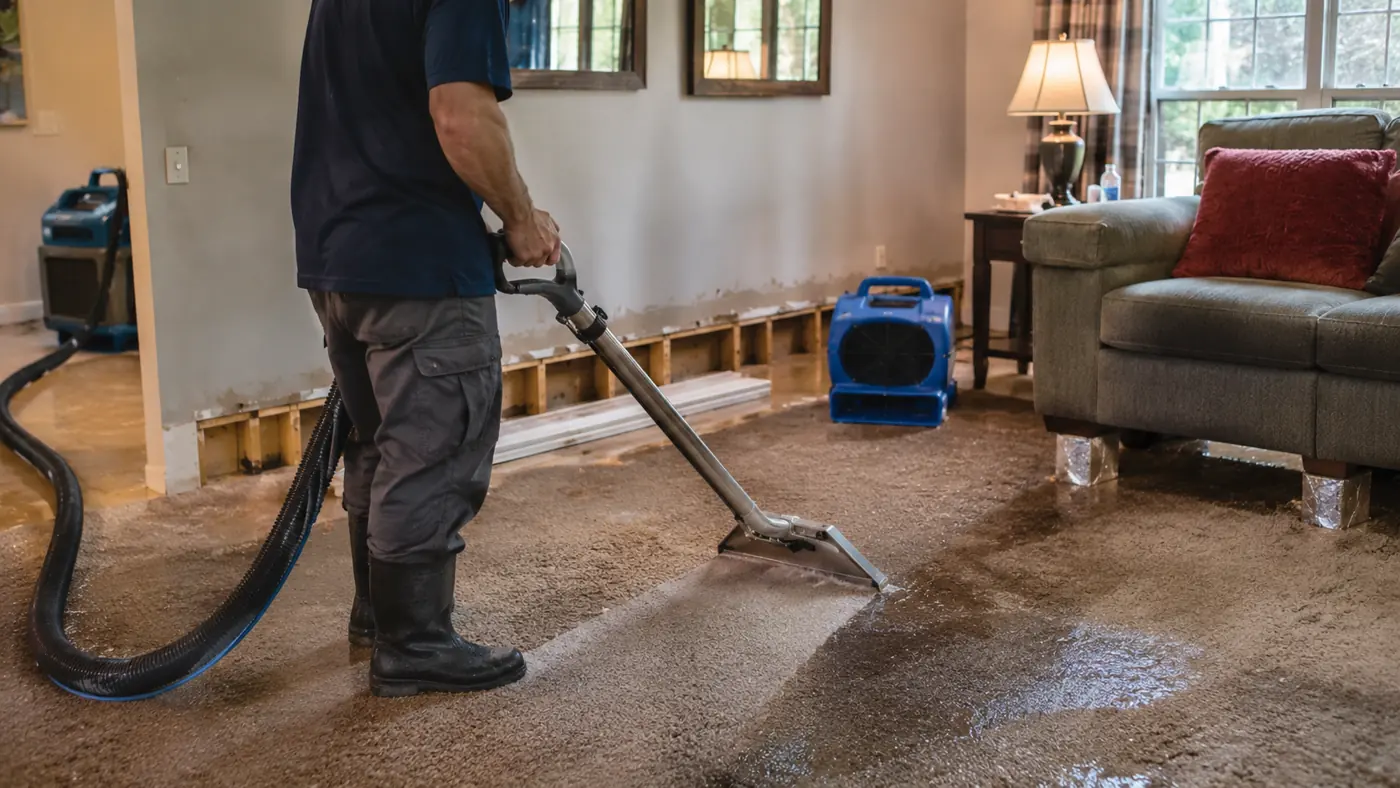
Emergency water removal and what happens on arrival
We confirm the source is off and the power situation is safe. Then we choose equipment based on what is on the floor. Standing water goes first, using a submersible pump if it is deep enough. Carpet and pad are extracted with a wand tool on a truck-mount or portable extractor, working in overlapping passes. On wet hardwood, tile and vinyl we use extractors with hard-floor tools and then place drying mats or air movers.
We take moisture readings before and after extraction. Extraction should remove most of the loose water, but it never gets everything. What is left in the pad, the subfloor and the bottom plate of the wall is what the structural drying stage deals with.
Signs you need extraction, not just drying
- You can see water, or your socks get wet when you step on the carpet.
- Carpet squishes when pressed.
- Water has pooled in a low spot or against a wall.
- A sump pump failed and the pit is full.
- Rain came in under a door or through a window.
Choose this when
- Standing water or soaked carpet and pad.
- Water on a slab, basement floor or crawlspace.
- Any time you can see or hear water moving.
Not the right fit
- Walls that are damp but the floor is dry: structural drying.
- Sewage in the water: sewage backup cleanup.
- Water only in the crawlspace: crawlspace water removal.
Standing water pump out from a slab, crawlspace or basement
Where the water sits changes the tools, the access and the price. A slab-on-grade room is the simplest. A basement adds stairs, finished walls and possibly a sump pit. A crawlspace adds a tight, dirty, low-clearance space where the crew works on their knees and sometimes on their bellies.
| Where | How we remove the water | What makes it harder | What to expect |
|---|---|---|---|
| Slab (garage, ground floor) | Extractor and wand on carpet, squeegee and pump for pooled water | Water that has run under baseboards | Usually one visit to extract, then drying |
| Basement | Submersible pump for depth, extractor on carpet, then drying mats | Finished walls, stairs, sump failure, ongoing seepage | Pump first, find why it flooded, then dry |
| Crawlspace | Small pump into a discharge hose, wet vac for what is left | Low clearance, vapor barrier trapping water, red clay mud | Water often keeps returning until the source is handled |
Why Kennesaw basements and crawlspaces refill
Heavy rain on saturated red clay is the usual setup for a Kennesaw basement or crawlspace. The clay slows drainage, so water pools beside the foundation and pushes in through the lowest opening. When we pump, we also look at where the water is coming from: a downspout dumping next to the wall, a lot that slopes toward the house, or a sump discharge line that has been routed to the wrong place. Pumping a space that refills in an hour solves nothing.
The September 2009 flood is the local benchmark. The NWS recorded a 24-hour rainfall of 21.03 inches in Douglas County, and Noonday Creek at Woodstock crested at 19.66 feet against a 10-foot flood stage. Most storms are much smaller, but houses near a creek or in a low spot should plan on that kind of event happening again.
Sources: NWS Peachtree City, crest table; NWS, 2009 flood anniversary page.
How much water is on that floor?
Water depth over 1,000 square feet of floor. One inch is about 620 gallons, which is why a room that looks like a puddle holds more than you would guess.
Roughly 0.62 gallons per square foot for each inch of depth. Carpet pad and the bottom of the walls hold water on top of what you can see.
What to do before we arrive
- Shut off the water at the main if a line is the source.
- Turn off power to the wet area only if the breaker panel is in a dry spot.
- Do not run a household vacuum on standing water.
- Photograph the water line on walls and furniture before anything moves.
- Lift small items and furniture legs off wet carpet. Put foil under legs that cannot move.
What water extraction costs
Extraction is usually folded into the per-square-foot mitigation price in published guides, which run about $3 to $7.50 depending on contamination. In our planning model it appears as its own line, $0.75 to $2.00 per square foot of wet area, on top of the drying line. Deep standing water, crawlspaces and after-hours calls move the number up.
| Job | Planning range |
|---|---|
| Extraction only, one room (about 200 sq ft), clean water | $150–$400 |
| Extraction, drying and carpet pad removal, one room (200 sq ft), clean water | $1,100–$2,200 |
| Basement, 600 sq ft, clean standing water, carpet out, drywall cut under 2 ft | $3,300–$7,400 |
Planning ranges, not a quote. A written scope after an on-site look is the only real number. Call (678) 940-0778. Use the water extraction cost calculator.
Sources: Angi; Fixr; HomeAdvisor.
Water extraction questions
Can I rent a wet vac and do this?
For a small area on a hard floor, yes. A shop vacuum does not remove water from pad or from under a floor, and it does not tell you what is still wet. Anything bigger than a bathroom floor is a pump and extractor job.
How soon should extraction start?
As soon as you can get a crew. Water spreads into baseboards, wall bottoms and subfloors within hours, and each hour widens the area to dry.
Do you save the carpet?
Sometimes. Clean water caught within a day or so can often be extracted and dried in place, with the pad replaced. Gray or black water means the carpet goes.
What if it keeps coming back?
Then we look for the source, such as a failed sump, a drain line, or groundwater. We tell you what we find. Plumbing, grading and sump repairs belong to other trades.
Related services
Water on the floor right now? Call us. (678) 940-0778