
Mold removal after water means fixing the moisture source, sealing off the area, removing mold and materials that cannot be cleaned, cleaning with HEPA vacuums, drying, and checking that the area is clean. Removing mold without fixing the water only buys time.
Mold needs three things: moisture, something to eat, and time. Drywall, wood, insulation and carpet are all food. Water is the one you can control. Many guides say wet materials should be dry within about one to two days, which is why we push to start drying right away after a leak.
What mold needs to grow
Take away any one of these and it stops. Moisture is the one you can control.
Moisture
A leak, a flood, a damp crawlspace or steady humidity.
This is the one we fixFood
Drywall paper, wood, insulation, carpet and pad all feed it.
Time
Wet material that stays wet for a day or two is at risk.
The drying clock after a leak
Many guides say wet materials should be dry within about one to two days. This is why we start drying right away.
Sources: EPA, A Brief Guide to Mold, Moisture and Your Home.
Our mold services
Mold work after water comes in a few parts. Which ones your house needs depends on where the growth is and how far it spread.
Moisture source check
A meter and a thermal camera find the wet material and the leak behind it. Nothing else holds until the water is fixed.
Containment and air scrubbing
Plastic sheeting around the work area and, on larger jobs, a HEPA air scrubber, so spores stay out of clean rooms.
Removal of mold-damaged material
Drywall, insulation, carpet and pad with growth are cut out, bagged and carried out.
HEPA vacuuming and cleaning
Framing and hard surfaces are HEPA-vacuumed and cleaned with a damp method.
Crawlspace mold cleanup
Wet insulation out, joists cleaned where the wood is sound, and the space dried.
Attic mold cleanup
Affected insulation and sheathing cleaned or removed, plus a fix for the vent or leak that fed it.
Wall-cavity mold
We open the wall, find the source, remove what is affected and dry the framing before it closes.
Clearance coordination
When you want proof, an independent tester checks the area afterward. We schedule around it.
Mold after a water leak
If a leak or flood was dried fast, mold is rarely a problem. If it was not, mold can start inside walls, under carpet and above ceilings where nobody sees it. A musty smell is often the first sign. Dark spots on drywall, bubbling paint, and a ceiling stain that returns after painting all point the same way. Fix the water first. If the source is still active, remediation will not hold.
Choose this when
- Visible growth on drywall, joists, subfloor or insulation.
- A musty smell that stays after cleaning.
- Growth after a leak or flood that sat for days.
Not the right fit
- A small patch under about 10 square feet on a hard surface, with the cause fixed: EPA guidance says homeowners can often handle it.
- Wet material with no mold yet: structural drying.
- Sewage or flood-water mold: needs a crew.
Mold remediation for Kennesaw homes and what is actually done
- Find and fix the moisture. If it is still wet, nothing else will last.
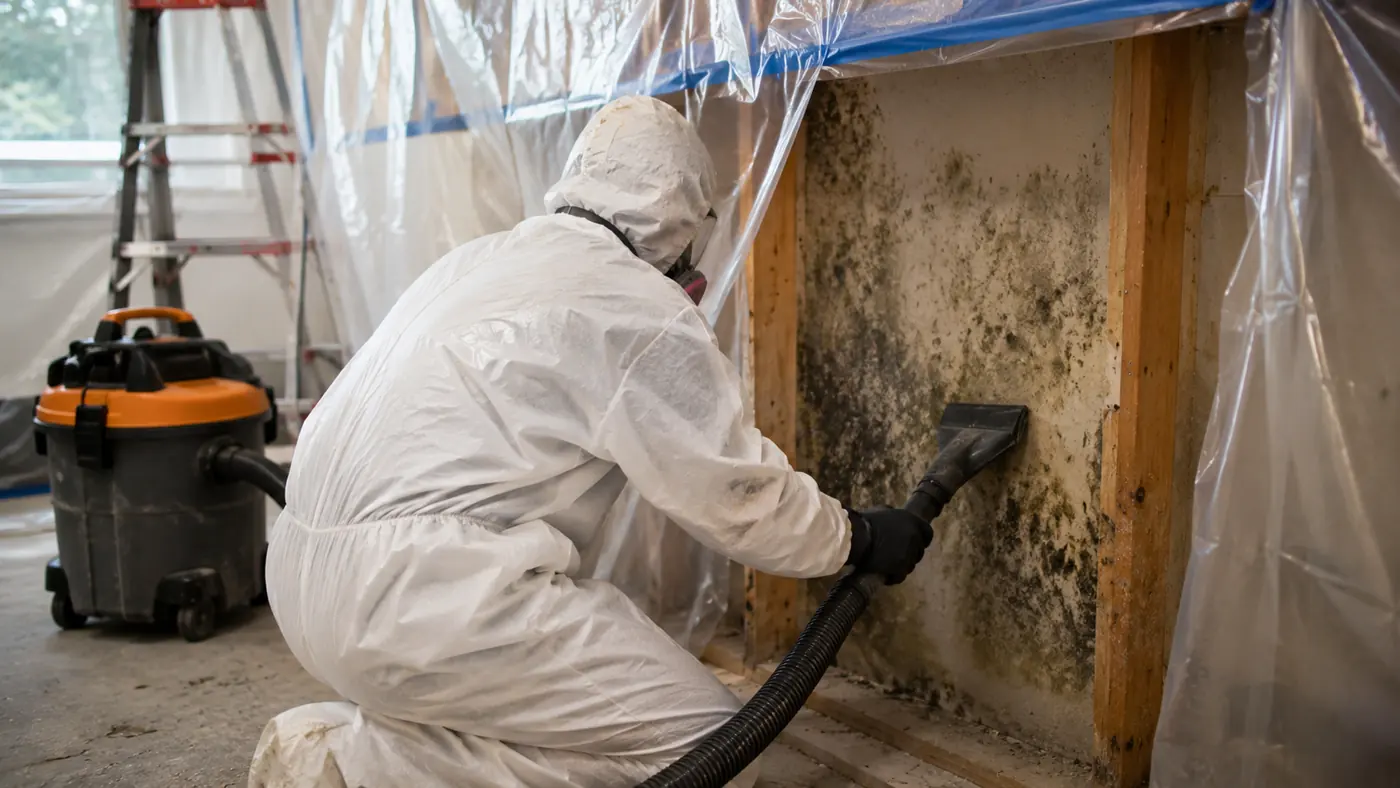
- Containment. Plastic sheeting and, for larger jobs, negative air pressure with a HEPA air scrubber, so spores are not spread to clean rooms.
- Removal of porous material. Drywall, insulation and carpet with growth are cut out, bagged and removed.
- HEPA vacuuming and cleaning. Framing and hard surfaces are HEPA-vacuumed and cleaned with a damp method.
- Drying. The space is dried down to normal moisture readings.
- Check. We inspect, and where testing is wanted, a third party tests for clearance.
Black mold in a crawl space
Dark growth on crawlspace joists is common in humid parts of Georgia, especially in houses where moisture came in through a leak, vents or high ground water. The color alone does not tell you the type, so we do not diagnose by color. Joists can often be cleaned in place when the wood is sound. Insulation and vapor barriers with growth are removed. Without a moisture fix, growth returns. We separate remediation from encapsulation: one cleans, the other seals the space against moisture. They are different jobs.
Musty smell in the house
A musty smell means something is damp. It could be a crawlspace, a basement, a wall cavity, an HVAC drain pan, or carpet that was never fully dried. We look for the moisture with a meter and a thermal camera. Sometimes the answer is just humidity; sometimes it is a small hidden leak. Do not cover the smell with a spray. Find the water.
Attic mold removal
Attic mold is usually from bathroom fans venting into the attic instead of outside, a roof leak, or poor ventilation in a humid climate. The roof sheathing and rafters get dark, and insulation holds moisture. Remediation includes cleaning or removing affected material and fixing the vent, leak or ventilation. Working in an attic in July is hard, so jobs are scheduled for cooler hours.
When testing makes sense
Testing is useful in a few cases: a dispute over what is present, a requirement from an insurer, or a clearance test after remediation to show the area is clean. It is not needed to decide whether to remove visible mold. A tester should be independent of the company that does the removal so there is no conflict. Test cost is separate and set by the tester.
Where mold hides in a house
These are the six places we are called to most after a water event.
- AtticBath fan venting into the attic, roof leak
- Inside wallsA hidden leak in a supply or drain line
- BathroomLeaks behind tile, poor ventilation
- HVAC and ductsCondensation and leaks
- BasementSeepage, flood, high humidity
- CrawlspaceWet ground, leaks, vents in humid weather
| Place | Common cause | Typical approach |
|---|---|---|
| Crawlspace | Wet ground, leaks, vents in humid weather | Remove wet insulation, clean joists, dry, address moisture |
| Attic | Bath fan venting into attic, roof leak | Clean or remove material, fix vent or leak |
| Basement | Seepage, flood, high humidity | Remove wet drywall, dry, clean |
| Bathroom | Leaks behind tile, poor ventilation | Open wall, remove affected material, repair source |
| Inside walls | Hidden leak | Open, find source, remove, dry |
| HVAC and ducts | Condensation, leaks | Duct specialist and HVAC technician involved |
What not to do before we arrive
- Do not scrub, sand or brush dry mold. It sends spores into the air.
- Do not blow a fan across moldy material.
- Do not paint or caulk over growth or a stain. It hides the problem and the stain comes back.
- Do not cut into a wall with heavy growth without protection. Wear a fitted N95 or better and gloves if you must go in.
- Do not keep sleeping in a room with a wet, musty ceiling or wall.
Keeping mold from coming back
After remediation the job is moisture control. EPA guidance says to dry wet material within 24 to 48 hours, fix leaks quickly, and keep indoor humidity below 60 percent, ideally between 30 and 50 percent. In practice that means:
Fix the leak and the cause
A dry wall with a dripping supply line behind it is a future mold call.
Run the bath fan and vent it outside
A fan that vents into the attic puts the moisture in the attic.
Watch the humidity
A cheap hygrometer shows whether the basement or crawlspace stays damp in summer.
Dry anything that gets wet, fast
Fans and a dehumidifier within the first day beat cleanup a week later.
Sources: EPA, A Brief Guide to Mold, Moisture and Your Home.
Humid summers and mold in Kennesaw
Humid Georgia summers keep damp materials from drying on their own. Crawlspaces on red clay hold moisture long after the rain stops. A house that took on water in June and was not dried can grow mold in weeks. Winter is calmer, but a burst pipe that went unnoticed behind a wall in a closed house can do the same. If you are unsure whether a smell or stain is from an old leak, a moisture meter is faster than guessing.
Mold removal cost
Published guides put professional remediation at about $10 to $25 per square foot, with crawlspaces and attics often running higher per square foot because of access, and typical crawlspace totals of $500 to $2,000 and attic totals of $1,000 to $4,000. Testing, fixing the moisture source, and rebuild are separate.
| Scope | Planning range |
|---|---|
| Small bathroom patch, 15 sq ft, drywall removal | $500–$800 |
| 250 sq ft attic, visible growth, insulation removed | $2,500–$8,750 |
| 400 sq ft crawlspace, visible growth | $3,200–$13,000 |
Planning ranges at a glance
Each bar spans the low and high end of our planning range for that example. Wider bars mean more that depends on what we find.
Scale runs from $0 to $14,000. Planning ranges only, mitigation without testing, moisture fix or rebuild.
Planning ranges, not a quote. A written scope after an on-site look is the only real number. Call (678) 940-0778. Mold removal cost calculator.
Sources: Angi mold remediation cost; This Old House; Fixr; EPA, Mold Cleanup in Your Home.
Mold removal questions
How fast does mold grow after water?
It can begin within about a day or two on wet, warm materials. Fast drying is the best prevention.
Do I need to leave my house?
For small jobs, usually not. For larger jobs with containment, we may ask you to stay out of the work area.
Will bleach fix it?
Bleach does not solve a moisture problem and does not penetrate porous materials. Removal and drying do.
Does insurance cover it?
Many policies cover mold that follows a covered water event and exclude mold from long-term leaks or neglect. Check your policy.
Is mold in my house dangerous?
It can cause allergy-type symptoms in some people, such as sneezing and irritated eyes and throat, and it can bother people with asthma. We do not diagnose health effects. If someone in the house is sick, talk to a doctor and keep them out of the work area.
How long does a mold job take?
Small areas can be done in a day or two. Larger jobs with containment and drying take longer. We give you a schedule after we see the space.
Do you test first?
Not always. Testing is useful for clearance or a dispute. Visible growth does not need a test to justify removal.
Related services
Water on the floor right now? Call us. (678) 940-0778